How Do Distributors Find the Exact Words Their Buyers Use?
This article goes deeper on Step 1 from How Can Distributors Get Recommended by AI Search? 6 Steps to Make the Shortlist. Each article in the series covers one step.
Distributors show up in AI Search answers more often when their website uses the same words buyers use when they ask. Buyers type their questions into ChatGPT, Perplexity, and Google the way they talk, so the fastest way to match them is to collect their exact wording from sales calls, quote requests, emails, and online communities, then build your content around those questions.
Key takeaways:
- Buyers’ questions are the prompts they type into AI. Your content should sound like them.
- Your best source is already in-house: sales calls, quote requests, and the questions your counter staff hear every day.
- Copy the exact wording, not a summary. Summaries can lose the words you need.
In this article:
- Why do your buyers’ exact words matter for AI Search?
- Where do you find the words your buyers use?
- Why copy the exact wording instead of an AI summary?
- What do buyer questions sound like?
- How do you turn buyer questions into content?
- FAQs
Why Do Your Buyers’ Exact Words Matter for AI Search?
AI Search matches questions to pages, and pages that use the buyer’s own words are easier to match. When a buyer asks ChatGPT a question, the AI often runs live searches behind the scenes, using several versions of that question. Pages that rank for those versions are the ones it reads and quotes.
Distributor websites describe product categories, line cards, and value-added services, and that’s exactly what they should do. We’ve been telling distributors to put that information on their websites for years, and buyers still need it. But buyers rarely start there when they ask for help. They describe a problem they need solved, a job they’re working on, or a deadline they’re up against. When the words on your website don’t match the words in a buyer’s question, AI has a hard time connecting your company to what the buyer needs.
Where Do You Find the Words Your Buyers Use?
Start with your sales team’s call recordings. Pull the last 20 calls and write down every question a prospect asked. Then widen the net:
| Source | What to look for | Who can help |
|---|---|---|
| Sales call recordings | Every question a prospect asked | Outside and inside sales |
| Quote requests and contact forms | How buyers describe what they need | Whoever manages your website forms |
| Emails to inside sales and customer service | Follow-up questions and worries | Inside sales, customer service |
| Counter conversations | The questions asked every single day | Counter and branch staff |
| Reddit, Facebook groups, LinkedIn groups | How buyers talk shop with their peers | Marketing, or a rep who’s active there |
Why Copy the Exact Wording Instead of an AI Summary?
A summary will smooth out the very words you’re trying to capture. AI summaries tend to flatten language, giving you tidy, generic phrases that sound like a brochure. Your buyers don’t talk like a brochure, and they don’t ask questions like one either.
Copy the questions word for word into a spreadsheet. If your call recorder gives you both a summary and a transcript, use the transcript, because it keeps the buyer’s exact words.
What Do Buyer Questions Sound Like?
Every distributor’s list will be different, but the questions usually sound something like these examples:
“Who can get 200 of [product] to a jobsite in Nashville by Friday morning?”
This buyer is asking about a deadline, not a product category. Pages about stock levels, delivery options, and rush orders answer questions like this one.
“Our [usual brand] is on backorder. What else will work for the same job?”
Buyers need help with substitutions. A page that explains equivalent products, in the buyer’s terms, answers it.
“We keep running out of the same parts. Is there a supplier who will manage our stock for us?”
The buyer is describing a problem, not asking for “vendor-managed inventory.” Use their wording on the page that explains your program.
“What’s the best option for a wet, cold environment like a food processing plant?”
Buyers search by application. Content organized around the job and the environment matches how they ask.
None of these questions uses the language of a product category page, and each one is a question AI will try to answer for your buyer.
How Do You Turn Buyer Questions into Content?
Once you have the raw list, let AI do the pattern-finding, not the collecting.
- Set up a simple spreadsheet with four columns: the exact question, where it came from, the date, and the page on your site that answers it (or “none yet”).
- Ask AI to find the patterns. Which phrases repeat? How do buyers describe the problem? What are they worried about: lead times, substitutions, pricing, minimum orders?
- Aim for 20 to 30 core buyer questions. Turn each one into a page heading, an FAQ, or a full article.
- Use the buyers’ words in your headings. Phrase subheadings as the question itself, and work anonymized buyer quotes into your articles.
- Refresh your list every two to three months. New products, new problems, and new language show up all the time.
Start This Month
Pull the questions from your last 20 sales calls and quote requests. Copy the exact wording, not a summary. It takes a few hours, and it tells you exactly what to write next.
FAQs
How many buyer questions does a distributor need to start?
Twenty to thirty is plenty. That’s enough to see patterns and fill a content plan for months. You can always add more as new questions come in.
What if our sales team doesn’t record calls?
Ask reps and counter staff to jot down prospect questions word for word for two weeks. Quote requests, contact forms, and customer service emails are already in writing, so start there.
Can we use AI to transcribe sales calls?
Yes. A transcript keeps the buyer’s exact words, which is what you want. Just don’t stop at an AI summary of the call, because summaries replace the buyer’s language with generic phrasing.
Where do buyer questions go once we have them?
Into headings, FAQs, and new articles on your website, and into your monthly AI prompt test. The six-step article shows how Step 1 feeds every step after it.
Next week: Step 2, and how to describe your company so AI recognizes it.
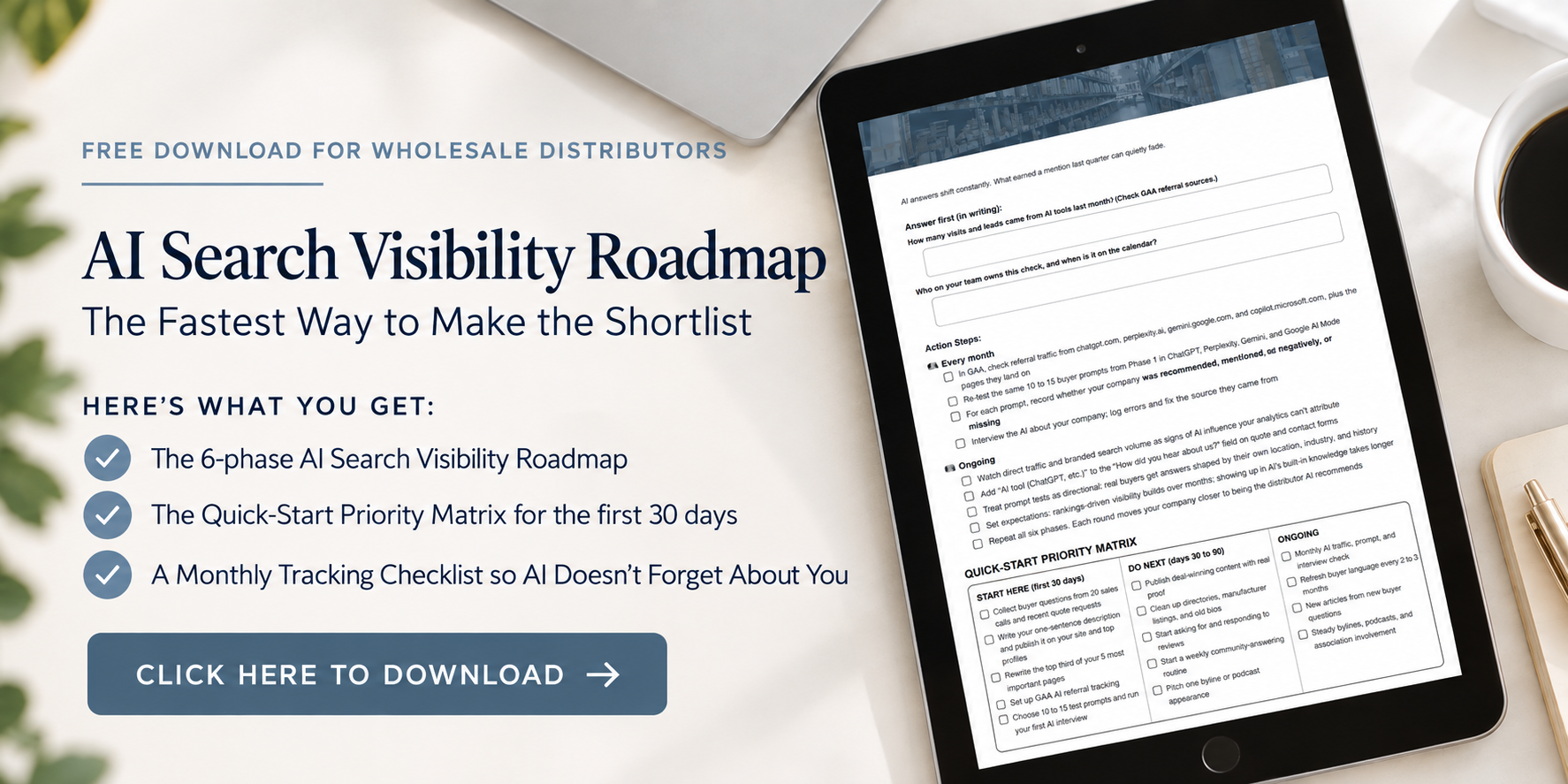
Want the free AI Search Visibility Roadmap with all six steps?
Susan Merlo is the founder of The Digital Distributor, a consultancy that builds marketing functions exclusively for wholesale distributors. She is the author of The Digital Distributor: Six Steps to Accelerate Sales, published by Modern Distribution Management. Learn more at thedigitaldistributor.com.
Disclosure: The ideas and expertise in this article are mine; AI assisted with research and editing. Every recommendation reflects my own experience working with distributors.