Part 4B in a series about AI Search Strategies for Wholesale Distributors
This is the second half of Article 4 in my series on how distributors get recommended by AI Search. Part 4A covered how buyers build their shortlist before they ever talk to sales. This one covers the six steps to get on it.
Distributors get recommended by AI Search by making it clear to buyers and AI tools that they are right for the job, using information that is accurate, specific, and backed up by others. That requires six steps: learn your buyers’ exact language, describe your company the same way everywhere, publish pages that answer buyer questions up front, earn third-party trust, show up where buyers ask questions, and check every month what AI says about you.
It matters because we’re finding that buyers now pick their preferred supplier before they talk to sales. In 6sense’s 2025 Buyer Experience Report, the winning vendor was already on the buyer’s Day One shortlist 95% of the time.
Key takeaways:
- AI recommends distributors it clearly recognizes as suitable, so use one consistent company description on your website, profiles, and directory listings.
- Pages that lead with the answer and show proof are the ones AI quotes.
- Third-party confirmation, from manufacturers, associations, publications, and reviews, builds the trust AI looks for.
- Monthly tracking shows whether AI recommends your company, mentions it, or leaves it out.
In this article:
- How can distributors get recommended by AI Search and be included in the buying journey before the first sales call?
- Step 1: Are you using the exact words your buyers use?
- Step 2: Does AI describe your company the same way everywhere?
- Step 3: Is your content answer-ready?
- Step 4: Who else confirms what your website says?
- Step 5: Are you answering buyer questions where they already talk?
- Step 6: How do you know if AI is influencing your buyers?
- FAQs
How Can Distributors Get Recommended by AI Search and Be Included in the Buying Journey Before the First Sales Call?
Distributors win the pre-call stage by making it clear to buyers and AI tools that they are right for the job, using information that is accurate, specific, and backed up by others. Doing so comes down to six steps. Each one below explains what it means for a distributor and what to do first, so you can start this month without overhauling everything at once.
| Step | What it means for a distributor | Where to start this month |
|---|---|---|
| 1. Know your buyer | Capture buyers’ exact words | Pull questions from 20 recent sales calls and quote requests |
| 2. Get recognized by AI | One consistent description everywhere | Write one sentence: who you are, what you supply, who you serve |
| 3. Answer-ready content | Clear answers up front, easy-to-scan sections | Rewrite the top third of your five most important pages |
| 4. Trust and authority | Others confirm what you say | Update manufacturer and association listings; ask for reviews |
| 5. Be where decisions are made | Answer questions in buyer communities | Set keyword alerts and answer two threads a week |
| 6. Track and improve | Monitor what AI says and sends you | Start a monthly AI referral and prompt check |
Based on the Get Recommended framework by Gert Mellak, adapted to distribution.
Step 1: Are You Using the Exact Words Your Buyers Use?
Your content should sound like your buyers’ questions, because their questions are the prompts they type into AI. Your sales team’s call recordings are still the best place to start. Pull your last 20 calls and extract every question a prospect asked.
Then widen the net:
- Quote requests and contact forms
- Emails to inside sales and customer service
- Questions your counter staff hear every day
- Reddit threads, Facebook groups, and LinkedIn groups where your buyers talk shop
Copy the exact wording into a spreadsheet, not an AI summary of it. Then use AI to find the patterns: the phrases buyers repeat, how they describe problems, and what worries them. Build content around those questions, and work anonymized buyer quotes into your articles. When a distributor’s website uses the same language buyers use in their prompts, AI is far more likely to match that website to the question.
Step 2: Does AI Describe Your Company the Same Way Everywhere?
AI trusts a company it can recognize, and it recognizes a company through consistent, repeated descriptions.
Write one plain declarative sentence that says who you are, what you supply, and who you serve. For example: “[Your company name] is an industrial safety supply distributor serving food processing plants across the Southeast.”
Use that sentence word for word on your homepage, About page, and footer; your LinkedIn and Google Business Profile; association and industry directory listings; manufacturer “where to buy” pages; and any guest bio or podcast profile.
Distributors change over time through acquisitions, new branches, and new lines, so old descriptions pile up. Each outdated listing you fix makes your company easier for AI to identify and describe correctly.
Step 3: Is Your Content Answer-Ready?
Answer-ready content puts the direct answer in the first third of the page and breaks the rest into sections that make sense on their own.
AI tools pull individual sections, not whole articles, and most citations come from the top of the page. So lead with the answer, use subheads phrased as questions, and name your company and the topic in each section instead of relying on pronouns like “we,” “us,” “it,” or “this.”
The most valuable answer-ready content captures what wins your deals. Think about the last ten deals your team won. What decided each one? Same-day availability on a critical product? A rep who knew the application? A vendor-managed inventory program that fixed a stocking problem the buyer couldn’t solve internally?
Publish each deciding factor with proof: the application, the numbers, the before and after, a photo, a comparison table. Effort and first-hand experience matter. A generic page any competitor could publish won’t earn a recommendation. A specific story only your company can tell will.
Step 4: Who Else Confirms What Your Website Says?
AI trusts what others say about a distributor more than what the distributor says about itself.
Third-party confirmation includes manufacturer partner pages, bylined articles in industry publications, trade association memberships, guest spots on industry podcasts, and customer reviews on Google and other review sites.
Referrals work the same way. When a colleague recommends your company, the buyer’s next step is usually a Google search or an AI question to check you out. Consistent third-party mentions reinforce the referral.
Reviews deserve special attention: a single visible negative review can be enough for an AI tool to steer buyers elsewhere, so respond to reviews and keep your profiles current.
Step 5: Are You Answering Buyer Questions Where They Already Talk?
Many buying decisions start in communities, not search engines.
Maintenance, safety, and purchasing professionals ask each other for advice in Reddit threads, Facebook groups, LinkedIn groups, and association forums, and they listen to industry podcasts.
Set up keyword alerts for the problems your company solves, then have a knowledgeable rep or product specialist answer a couple of relevant questions each week. Don’t pitch. A helpful answer with a name attached ties your company to solving that problem, both for the people reading and for the AI tools that read those threads later.
Step 6: How Do You Know If AI Is Influencing Your Buyers?
Distributors can measure AI influence with a short monthly routine plus a few indirect signals.
The monthly routine:
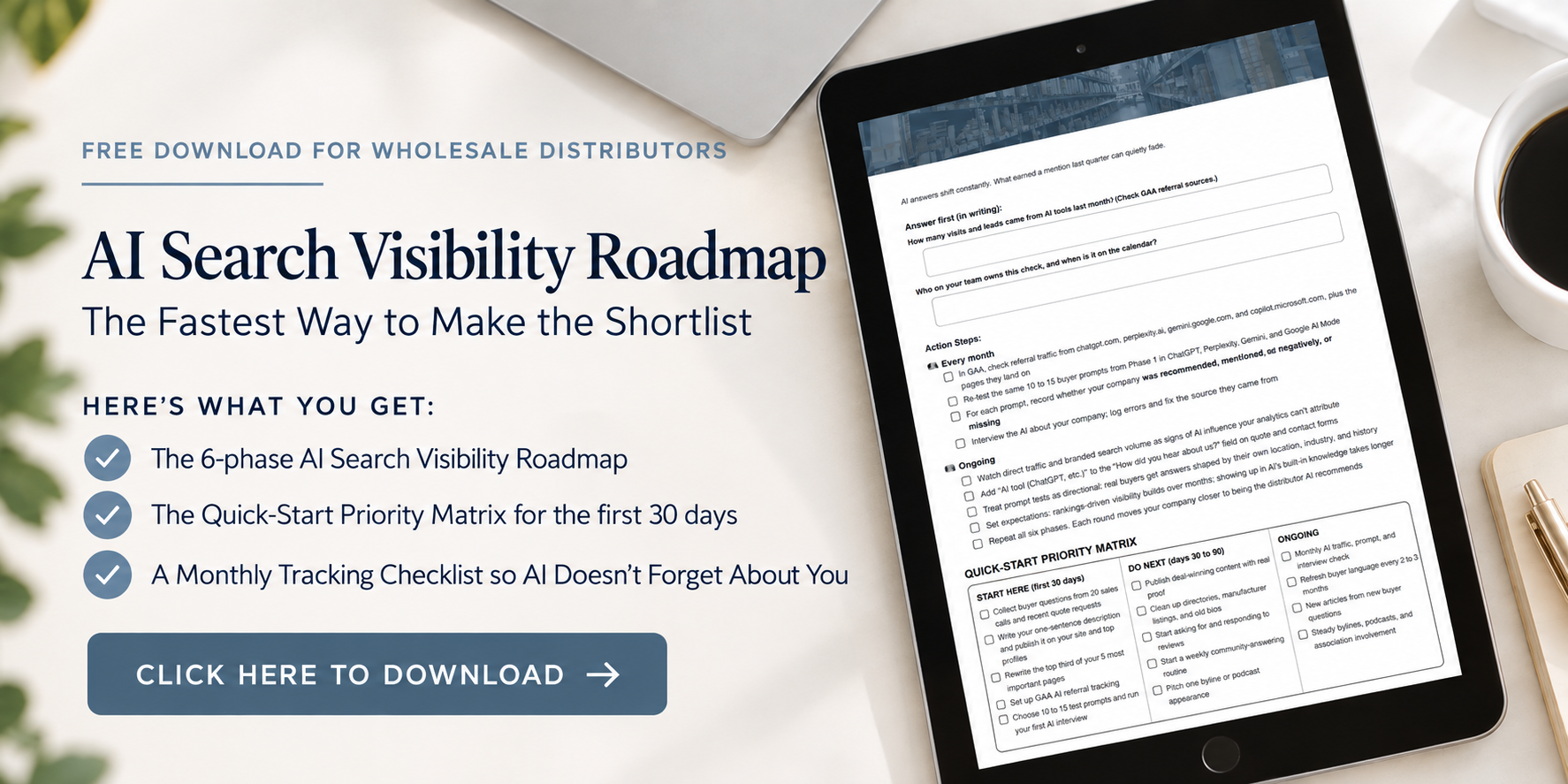
- Check AI referral traffic in GA4. Look for visits from ChatGPT (chatgpt.com), Perplexity (perplexity.ai), Gemini (gemini.google.com), Claude (claude.ai), and Copilot (copilot.microsoft.com), and watch the trend and which pages they land on.
- Re-test a small set of buyer prompts. Use the same 10 to 15 questions each month and note whether your company is recommended, mentioned, or missing.
- Interview the AI about your company. Watch for errors, outdated details, and whether the description is getting more accurate.
AI influence also hides in your analytics. A buyer who researched you in ChatGPT and then typed your URL shows up as direct traffic, with no referral source. Rising direct traffic and branded search volume over the following months are good signs that buyers are finding you through AI and arriving already informed. Add an “AI tool (ChatGPT, etc.)” option to the “How did you hear about us?” field on your quote form to catch what analytics can’t.
Then repeat the six steps. Each round of buyer research, profile cleanup, new content, and new mentions moves your company closer to being the distributor AI recommends.
Conclusion
Getting recommended by AI Search isn’t a one-time project. It’s an ongoing process. Distributors that speak their buyers’ language, describe themselves consistently, publish specific answer-ready content, earn outside confirmation, and check every month what AI says give AI every reason to put them on the shortlist.
FAQs
Which step should a distributor start with?
Start with Steps 1 and 2. Knowing your buyers’ exact questions tells you what to write, and a consistent one-sentence description makes sure AI can identify your company. Both are quick: a few hours pulling questions from sales calls and quote requests, and an afternoon updating your website and top profiles. Content, reviews, and community work build on that foundation.
Does it matter if AI helped write our content?
It matters much less than the effort and firsthand experience the content shows. Search engines and AI tools favor content with real examples, proof, original data, tables, and specific expertise. Generic content, whether written by a person or by AI, rarely earns a recommendation. Using AI to help write is fine; the substance has to come from your company’s experience.
Do we need special software to track AI visibility?
No. Google Analytics 4 shows referral traffic from ChatGPT, Perplexity, Gemini, and Copilot. A spreadsheet of 10 to 15 buyer prompts, re-tested every month, shows whether your company is recommended, mentioned, or missing. Paid tracking tools exist, but they test prompts without each buyer’s personal context, so treat their scores as directional.
How long does it take for a distributor to start showing up in AI recommendations?
It depends on which path AI takes. When AI runs live searches, your visibility follows your search rankings, and new rankings typically take a few months to build, often six to eight months to reach page one. Showing up in what AI already knows from its training takes longer, often a year or more, and is harder to control. Part 4A explains both paths in more detail.
Susan Merlo is the founder of The Digital Distributor, a consultancy that builds marketing functions exclusively for wholesale distributors. She is the author of The Digital Distributor: Six Steps to Accelerate Sales, published by Modern Distribution Management.
Disclosure: The ideas and expertise in this article are mine; AI assisted with research and editing. Every recommendation reflects my own experience working with distributors.