Part 4A in a series about AI Search Strategies for Wholesale Distributors
6sense’s 2025 Buyer Experience Report found that B2B buyers make first contact about 61% of the way through the buying journey, and that 95% of the time the winning vendor was already on their Day One shortlist.
More of that early research now happens in AI Search tools like ChatGPT, Perplexity, and Google’s AI Overviews. If AI doesn’t recommend your company while buyers build that shortlist, your best rep may never get the call.
Key takeaways:
- B2B buyers make first contact about 61% of the way through the buying journey, usually with a ranked shortlist already in hand.
- The winning vendor was on the buyer’s Day One shortlist 95% of the time, according to 6sense’s 2025 Buyer Experience Report.
- AI Search has become a primary research tool for procurement, maintenance, and safety buyers evaluating distributors.
- Being mentioned by AI is not the same as being recommended. What AI says about your company matters as much as whether it names you.
In this article:
- How much of the B2B buyer journey happens before a distributor is contacted?
- What does an industrial buyer research before calling a distributor?
- How does AI-assisted research change the job of distribution marketing?
- How does AI decide which distributors to recommend?
- What does AI say about your company when buyers research your category?
- What can distributors do to make the shortlist?
- FAQs
This is the first half of Article 4 in my series on AI Search for wholesale distributors, which I started earlier this year. If you’ve read Article 1, Article 2 and Article 3, you’ll notice some of that advice is already out of date. That’s how fast AI Search is moving. Since then, new research has updated key numbers, including the often-quoted statistic that buyers are 70% of the way through their decision before contacting sales. We’ve also learned much more about how AI tools decide which companies to recommend, including how much they rely on live web searches and why being mentioned isn’t the same as being recommended. This article and my soon-to-come Article 4B reflect what’s working now.
How Much of the B2B Buyer Journey Happens Before a Distributor Is Contacted?
Most of it. For three years, 6sense’s Buyer Experience research put the buyer’s first contact with a seller at roughly 70% of the way through the journey. The 2025 study moved that point to about 61%, but buyers are not less decided. They are simply checking details sooner.
Buyers Pick Their Supplier Before They Call Sales
Key findings from 6sense’s 2025 Buyer Experience Report.
| 6sense 2025 Finding | What it Means for a Distributor |
|---|---|
| First seller contact at about 61% of the journey (down from about 70% in 2023 and 2024) | Buyers call a little earlier, but most of the evaluation is already done |
| 94% of buying groups rank their shortlist before contacting sellers | Your rep walks into a meeting where your company is already ranked |
| The winning vendor was on the Day One shortlist 95% of the time | Distributors that aren’t on the shortlist are rarely in the running |
| Buyers purchased from their pre-contact favorite 77% of the time | The first sales call usually confirms a decision rather than creating one |
The 6sense research covers B2B purchases broadly, not distribution alone. Your own sales team can tell you whether it matches your market: ask them how many prospects arrive at the first meeting with a short list and a favorite already in mind.
What Does an Industrial Buyer Research Before Calling a Distributor?
Industrial buyers research the category, the options, and the risks, and AI Search is increasingly where they do it.
Five or six years ago, a procurement manager evaluating a new MRO supplier asked colleagues for referrals, ran a few Google searches, browsed websites, and started making calls. The shortlist formed during the outreach itself.
Today, a procurement manager might open ChatGPT or Perplexity and spend 45 minutes on a string of questions like these:
- “What should I look for when evaluating a safety supply distributor for a food processing facility?”
- “What are the most reputable safety supply distributors in the Southeast?”
- “How does vendor-managed inventory work for safety consumables, and what are the trade-offs?”
- “What questions should I ask a distributor during an evaluation call?”
(As an aside, the four questions above would make for great articles on a distributor’s website.)
AI answers are also personal. ChatGPT and similar tools factor in what they already know about the person asking: their location, their industry, and their earlier conversations. Two buyers can type the same question and get different recommendations. The distributors that show up consistently are the ones clearly tied to a specific type of buyer and a specific problem.
By the time the buyer schedules a first call, they have opinions about your category, your competitors, and, very likely, your company, all shaped by research they did on their own time without your involvement.
How Does AI-assisted Research Change the Job of Distribution Marketing?
In distribution, your marketing will carry the sale through the stage where the shortlist is built. For decades, marketing at a distributorship generated awareness, drove inbound inquiries, and supported sales collateral. The sales team did the real work of education, differentiation, and persuasion.
That division of labor no longer matches how buyers work. When most of the evaluation occurs before first contact, a distributor’s website, articles, reviews, and third-party mentions constitute the sales conversation at that stage. How well AI can find, understand, and recommend your company now decides whether your sales team even gets an at-bat.
How Does AI Decide Which Distributors to Recommend?
AI tools answer a buyer’s question in two ways: by drawing on what they already know and by running live web searches on the spot. For distributors, the live searches are the part you can influence fastest.
Think of it like asking a knowledgeable colleague a question. Sometimes they answer from memory. Sometimes they say “let me look that up” and check a few sources first. ChatGPT, Perplexity, and Google’s AI do both.
How Would AI Already Know About a Distributor?
AI tools learn about companies through a process called training. Before a tool like ChatGPT is released, its developer has it read an enormous amount of text from across the internet: company websites, industry publications, directories, forums, and reviews. That reading is how AI learns which companies exist, what they do, and what people say about them.
Three things distributors should know about training:
- It’s a snapshot. Training stops at a cutoff date, often months before the tool is released. Anything published after that date isn’t part of what the AI “remembers” until a newer version is trained.
- There’s no way to submit your company. No form, no listing, no fee. A distributor gets into AI’s memory only by being described consistently on its own website and on other respected sites before the next version is trained.
- The developers decide what gets included. Even a great industry article about your company may not make the cut.
That’s why showing up in what AI already knows is slow, often a year or more, and hard for a regional distributor to control.
When Does AI Search the Web for Distributors?
AI tools run live web searches whenever a question needs current or specific information, such as who carries a product line, which suppliers serve a region, lead times, or locations. These searches happen in the background, and the buyer usually never sees them.
For example, when a buyer asks about safety supply distributors for food processing, the AI might quietly search “food-grade safety supplies distributor Southeast” and “vendor-managed inventory safety consumables.” The pages that rank for those searches are the pages AI reads. Then it filters by trust: does it know enough about each company, and do other websites back up what that company says about itself?
Two Ways AI Learns About Your Company
What AI already knows vs. what it looks up while answering a buyer’s question.
| What AI already knows (training) | What AI looks up live (search) | |
|---|---|---|
| Where it comes from | Text the AI read before it was released | Web searches run while answering |
| How current it is | Months to years old | Today |
| How a distributor gets in | Be described consistently across the web over time | Rank in search results for buyers’ questions |
| How fast you can influence it | Slow, often a year or more | Months, once your pages rank |
Two practical lessons for distributors:
- Google rankings still matter. AI reads the pages that rank near the top of search results. Create pages that answer the different questions buyers ask, like cost, lead times, and how your programs work, so your site shows up when AI searches.
- Recognition matters. A distributor that ranks but that AI doesn’t clearly understand or trust can still be left out of the answer.
What Does AI Say About Your Company When Buyers Research Your Category?
The fastest way to find out is to become your own buyer. Pick the customer your sales team most wants to win: a maintenance manager at a food processing plant, a purchasing director at a regional manufacturer, a safety coordinator at a multi-site contractor. Write down the questions that person would ask while evaluating a new supplier. Then ask ChatGPT, Perplexity, and Google’s AI Mode those questions, and follow the thread the way a real buyer would.
Look at what AI says, not just whether your company appears. AI tools sometimes name a brand and then say it’s not a good fit for the buyer’s situation. Check each answer for:
- Does your company show up for your core product categories and buyer types?
- Is it recommended, or only mentioned in passing?
- Is the description accurate and specific, or vague and outdated?
- Are competitors described with more confidence or more detail?
- Are there buyer questions nobody in your category answers well, a gap your company could own?
Then interview the AI about your company directly. Ask “Tell me everything you know about [Company],” “What do customers say about [Company]?” and “Who is [Company] a good fit for, and who should look elsewhere?” Gaps and errors in those answers point straight to what needs fixing.
Treat this test as directional. A clean test account can’t reproduce every buyer’s context, which is why pairing it with ranking reports and real traffic data gives the full picture.
Coming Next: What Can Distributors Do to Make the Shortlist?
Distributors make the shortlist by ensuring that everything buyers and AI tools find about them is accurate, specific, and corroborated by others. That comes down to six steps:
- Know your buyer: Capture the exact words buyers use.
- Get recognized by AI: Use one consistent description everywhere.
- Publish answer-ready content: Put clear answers up front, with proof.
- Build trust and authority: Get others to confirm what you say.
- Be where decisions are made: Answer questions in buyer communities.
- Track and improve: Check every month what AI says about you and sends you.
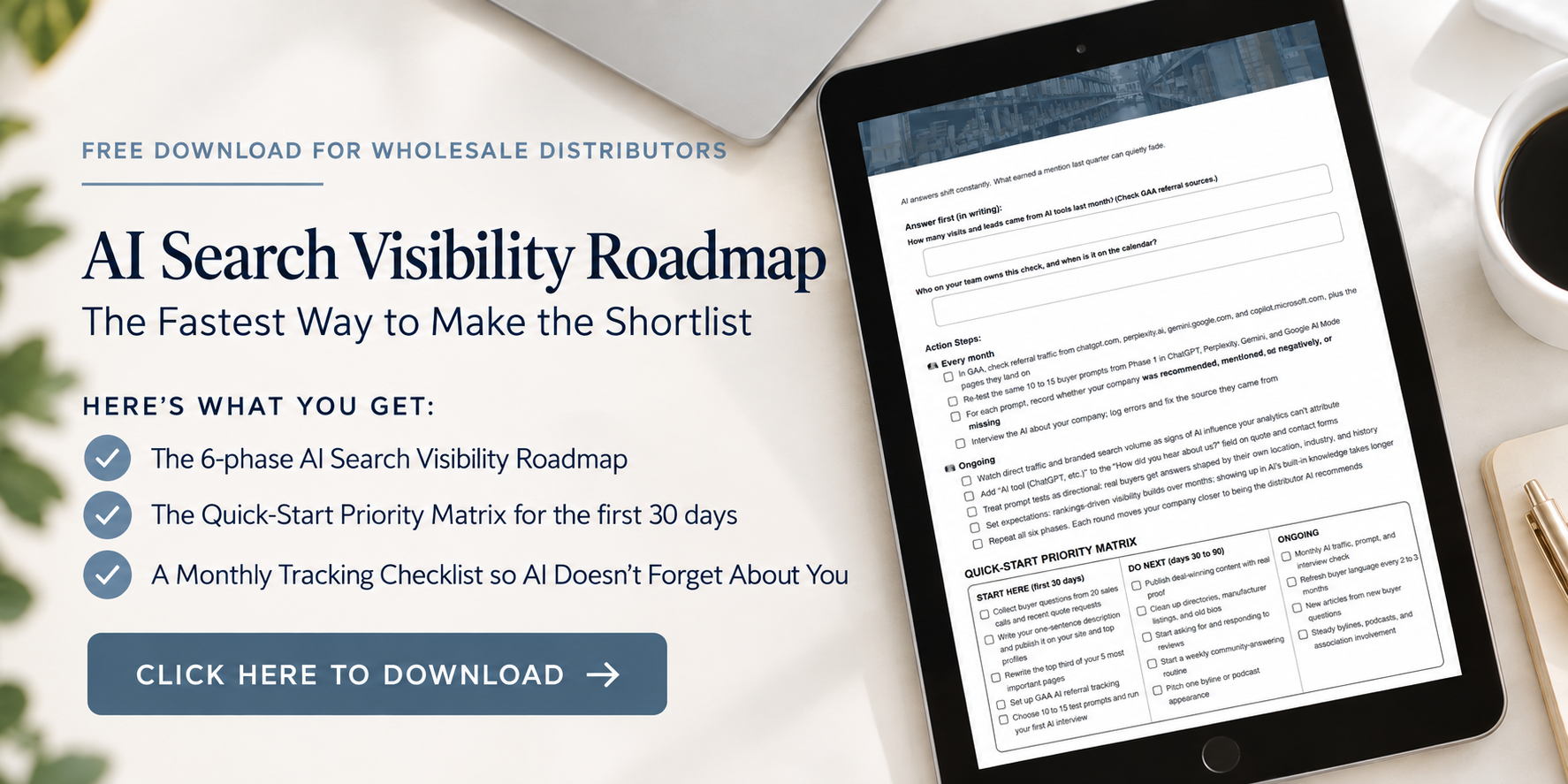
I’ll walk through each step in Article 4B, coming shortly. Can’t wait? All six steps are laid out in the free AI Search Visibility Roadmap.
*Based on the Get Recommended framework by Gert Mellak, adapted to distribution.
Conclusion
The B2B buyer journey is largely decided before your sales team gets the call, and AI Search increasingly shapes that decision. Distributors that understand how AI finds, judges, and recommends suppliers can make sure their company is on the shortlist before the first conversation, not discovered after it.
FAQs
Our sales team wins through relationships and referrals. Does the digital buyer journey really apply to industrial distribution?
Yes. Referrals remain powerful in distribution, but even referred buyers research before they reach out. When a colleague recommends a distributor, the buyer’s next step is usually a Google search or an AI question to validate that recommendation. What AI says during that check either reinforces the referral or raises doubts. The goal isn’t to replace relationship selling; it’s to make sure your online presence backs up the reputation your team has earned.
How do we know if buyers in our category are actually using AI Search?
Ask them, and check your data. Survey current customers about how they researched suppliers, and add an “AI tool” option to the “How did you hear about us?” field on your quote and contact forms. Check GA4 for referral traffic from ChatGPT, Perplexity, Gemini, and Copilot. Then run the buyer test yourself: ask AI the questions your buyers would ask and see what comes back. In many industrial categories, AI answers are thin, which gives early movers a real advantage.
If buyers decide before the first call, have we lost control of the sale?
No. The content you publish is your input during that stage. Every buying guide, case study, FAQ, and honest comparison page is your company taking part in the buyer’s research before the first conversation. Without that content, AI builds its picture of your company from competitors’ pages, third-party reviews, and whatever fragments it can find.
Susan Merlo is the founder of The Digital Distributor, a consultancy that builds marketing functions exclusively for wholesale distributors. She is the author of The Digital Distributor: Six Steps to Accelerate Sales, published by Modern Distribution Management.
Disclosure: The ideas and expertise in this article are mine; AI assisted with research and editing. Every recommendation reflects my own experience working with distributors.